Jet Rescue is getting busier every day. Demand across the air ambulance industry keeps growing, driven by an ageing population and rising international mobility. The team expects to maintain this pace all year.
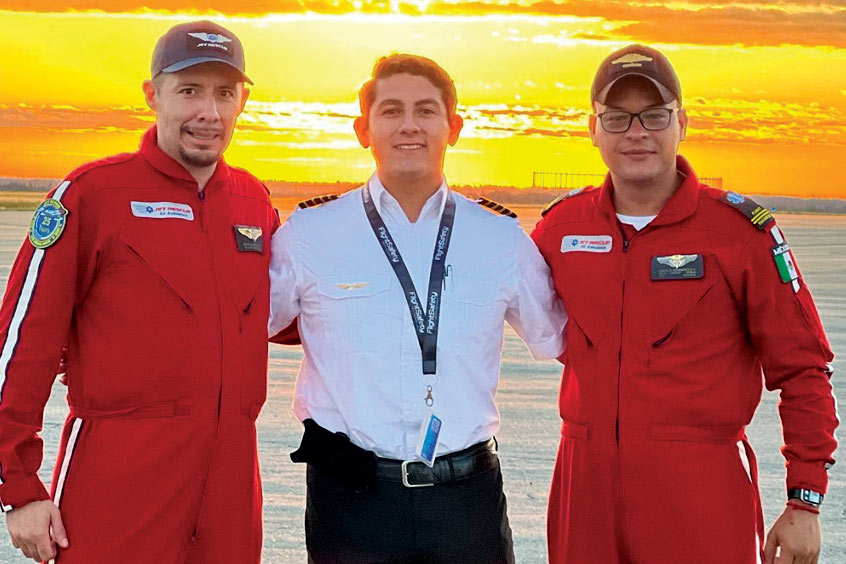
Mexican operator Jet Rescue Air Ambulance is celebrating 30 years in the sky. The company uses ‘workhorse’ Learjets including the LR60, LR36 and LR35, all of which are based in Mexico and Florida. Jet Rescue also operates a Bell 206L-3 helicopter, which is used for shorter-range work and at locations that are more difficult to reach.
Founder Carlos Salinas says: “We think of our medical jets as flying ICUs. The entire interior is modified to accommodate either LifePort or Spectrum Aeromed stretchers. The carpet has been replaced with medical-grade, high-traffic vinyl flooring, and all equipment is secured using aviation-approved mounts. Over the years we have continued to innovate, configuring our jets with dedicated medical interiors and the latest medical technology.
“As pioneers of the air ambulance concept in Mexico, we have consistently been first to adopt new capabilities. We were the first to fly LifePort stretchers, Zoll X Series monitors, Hamilton T1 ventilators and i-STAT analysers, among others. The result is a hospital-like environment that can fly you across borders. We were also the first in Mexico to carry patients on Impella 2.5 support and on ECMO. There is less cabin space than in a standard jet, of course. But it is built to save your life.”
Jet Rescue’s medical director and several colleagues in administration have been with the firm for more than two decades, along with a number of people in flight and medical operations. Employee fulfilment and wellbeing are important values at Jet Rescue. What motivates its longest-serving team members is the continuous learning environment, which allows them to grow professionally and stay at the top of their specialty, as well as the atmosphere of trust and care between everyone.
Jet Rescue has Mexico in its DNA and was the first air ambulance company created in the country.
Salinas continues: “I am very close to the reality of operations, because I started the company 30 years ago as its main paramedic. I know first-hand what daily life on board is like, and I believe that is one of the things that makes our collaboration so strong.
“Soon after forming we went international and became the first Latin American air ambulance operator to go binational, flying from both Mexico and our base in Miami. While the heart of our operations is the Americas – North, Central, South and the Caribbean – we operate worldwide. Over three decades we have flown across Western and Eastern Europe, the Middle East and Asia, as far as the Philippines. We can reach our patients and escort them home from anywhere, including the most remote environments. Two months ago, we rescued an injured person from the Galapagos Islands, some 600 miles out into the Pacific.”
Many exceptional missions have taken place. “On our 30th anniversary we remember a great many, but the one that comes to mind first is the world record we set in August 2020. It was without doubt one of the most ambitious transports ever undertaken by a private air ambulance service. We were the first civilian air ambulance company to transport an adult ECMO patient from Mexico to Korea, a distance of 12,000km that had previously only been achieved by the US military. It was a complex operation that demanded meticulous preparation. After fuel and oxygen stops in Canada, Alaska and Russia, we landed in Seoul exactly as planned, with a stable patient ready for a lung transplant. It was an exceptional day, and I could not be prouder of the professionalism and talent of the Jet Rescue team or of what it showed about how far our capabilities reach. On a gentler note, just a few weeks ago we assisted a mother through labour on board one of our Learjets. Our first Jet Rescue baby, so to speak, was born healthy at 31,000ft.”
Jet Rescue is getting busier every day: demand across the air ambulance industry keeps growing, driven by an ageing population and rising international mobility, and the team expects to maintain that pace all year. The global air ambulance market is currently estimated at $7.5 billion. By 2034 it is projected to reach $13 billion, a near twofold increase in just eight years.
Salinas concludes: “We are focused on streamlining operations. This year we began using our own custom-built software, which manages virtually everything in the company: operations, finance, scheduling, maintenance and training. We also continue to modernise our fleet and equipment, both to meet the latest aviation requirements and to support the growth in our activity.
“We are now entering the next 30 years of our story.”


