For the last decade, SkyCare has carried out road ambulance missions all over the UK. In a move expected to boost safety, reliability and speed, the organisation has plumped for a Pilatus PC-12NGX for aeromedical work.
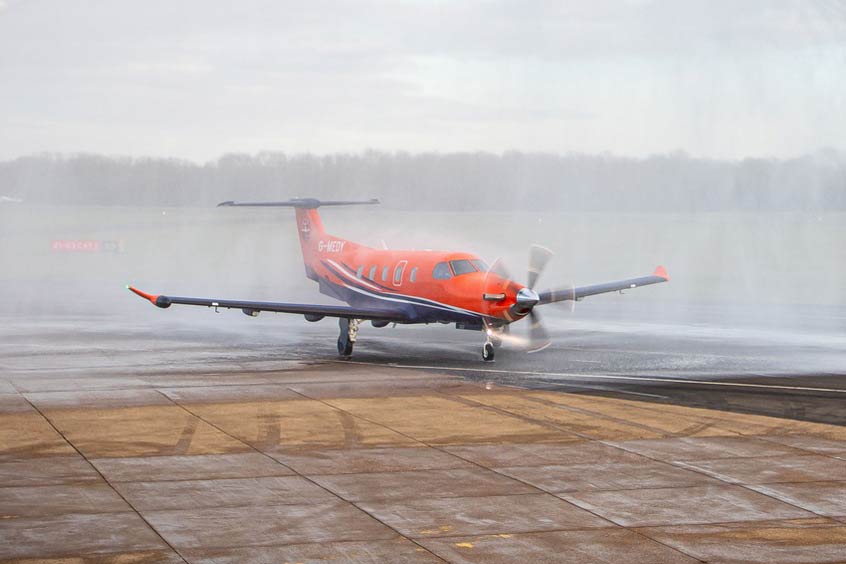

SkyCare Repatriation has launched London Biggin Hill airport’s first air ambulance service, operating a Pilatus PC-12 NGX to support critical care transport across Europe. The aircraft will operate under the AOC of Biggin Hill-based Oriens Flight Operations, which also manages the on-site Pilatus service centre.
The addition of the PC-12 NGX expands SkyCare’s comprehensive medical transport solutions, which already include a fleet of 60 ground ambulances. SkyCare now offers seamless patient transport from ground to air, providing services for health organisations, insurance providers and private clients.
SkyCare director Craig Bickers says: “While we’re relatively new to the aviation industry, we are by no means newcomers to patient repatriations. For the past decade, we’ve been transporting sick patients back from Europe using ground ambulances. However, we’ve often seen air providers secure the cases where patients have the budget to opt for air transport. Four years ago, we started planning to expand into air operations, and two-and-a-half years ago, we placed the order for our PC-12 NGX. The aircraft finally arrived last week, marking a major milestone for us.
“We chose the PC-12 NGX because it is uniquely suited to medical missions. Pilatus worked closely with the Royal Flying Doctor Service (RFDS) in Australia, whose feedback influenced the design to better serve medical needs. Features like the large rear cargo door allow easy loading and unloading of stretchers and equipment, solving a significant logistical challenge in patient transport. Unlike traditional business jets, which often have narrow doors unsuitable for larger patients, the PC-12 provides both space and accessibility, ensuring patients can be moved safely and with dignity.”
The PC-12 NGX is known for its reliability, cost-efficiency and ability to access smaller airfields, enabling it to reach patients in remote locations. SkyCare’s partnership with Oriens ensures access to on-site maintenance and operational support, enhancing the service’s reliability.
Bickers continues: “The aircraft’s high tail design allows ambulances to get close to the fuselage without risking damage, and being a single-engine turboprop makes it more fuel-efficient and cost-effective, with lower maintenance demands. For our mission profile – patient repatriations across Europe – the PC-12 NGX is the perfect fit. While our primary focus is Europe, we also have the capability to operate beyond if needed, carefully balancing distance and time efficiency.
“This exciting new venture operates under a newly established division called SkyCare Repatriation, while our existing service, BM Ambulance Group, continues to provide high-quality ground transport services. Over the past decade, we’ve built a strong reputation in the industry, and we’ve already seen significant interest in our new air ambulance service. We’re planning to go live in the second week of February, just in time for the tail end of the ski season, a period that traditionally generates higher demand for repatriation services through insurers.”
In addition to private and insurance-related work, SkyCare is keen to collaborate with the NHS. It has had promising discussions with London’s transport teams, giving them the option to transport adults, paediatric, and neonatal patients over long distances. “It’s about supporting the safe and efficient transport of critically ill patients, who traditionally would have been transported by road or helicopter over long distances,” Bickers explains. “For example, repatriations from London to Scotland or the West Country are not very economical by helicopter nor as safe as fuel stops have to be factored in. While these discussions are ongoing, we’re excited about the potential for SkyCare to enhance the healthcare landscape.”
He says being based at Biggin Hill has several advantages: “With access to 60 road ambulances, we can provide seamless, bed-to-bed patient management, ensuring the highest standards of care. We aim to be a valuable resource for the health services in London and across South East England, combining expertise in both ground and air transport.
“Currently, the aircraft is at Southend, where it’s undergoing modifications to install a medical stretcher system and power outlets, a process that takes approximately 14 days. Looking ahead, we’re also exploring partnerships with London-based companies that operate long-range aircraft equipped for medical missions. Such a collaboration would allow us to extend our services beyond Europe to regions like North America and Asia, broadening our reach and capabilities.”